My SIL Kicked Me Out of Her Wedding, Then Demanded My $230 Bridesmaid Dress for Free—AITA?
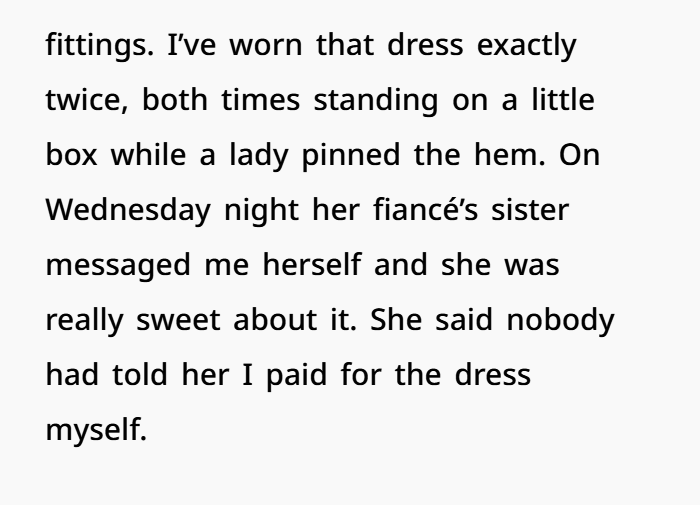
A woman spent $230 on a bridesmaid dress for her sister-in-law’s wedding, only to learn that she would no longer be part of the bridal party. The bride had invited her to be a bridesmaid in April, and she was happy to accept. Their relationship had always been good, so she was excited to help celebrate the wedding. In June, she visited a bridal boutique with the other bridesmaids and bought a burnt-orange dress chosen by the bride. She paid for it herself and went to the dress fittings. Everything seemed normal until a few weeks before the wedding, when the bride called with a change of plans.
The bride said her fiancé’s sister wanted to join the wedding party. She also wanted the same number of bridesmaids and groomsmen for the wedding pictures. To make room for the new person, she decided to remove the woman from her bridesmaid role. Although disappointed, the woman did not argue. But the next day, the bride asked her to hand over the dress to the replacement bridesmaid. She explained that ordering a new dress would take too long and that the dress should fit the other woman. The former bridesmaid was surprised because she had paid the full $230 and had not been offered any money in return.
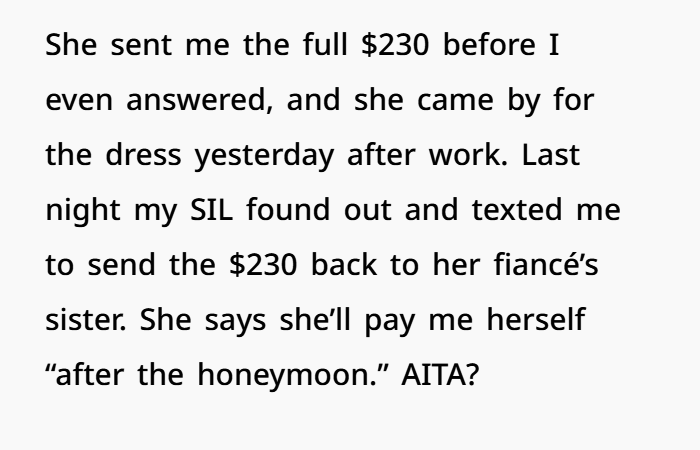
When the woman asked for a refund, the bride offered her only $100. She claimed the dress was no longer worth its original price because it had been worn during fittings. However, the woman said she had only tried it on twice while getting the hem adjusted. Soon after, the replacement bridesmaid reached out to her directly. She was polite and explained that she had not known who paid for the dress. She offered to buy it for the full $230. The woman accepted, received the payment, and gave her the dress. It was a simple solution that helped both women avoid losing money on wedding expenses.
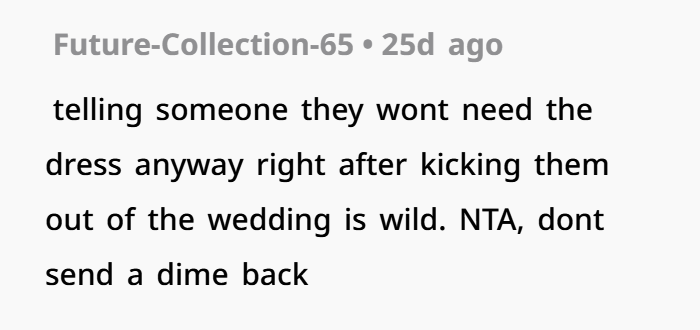
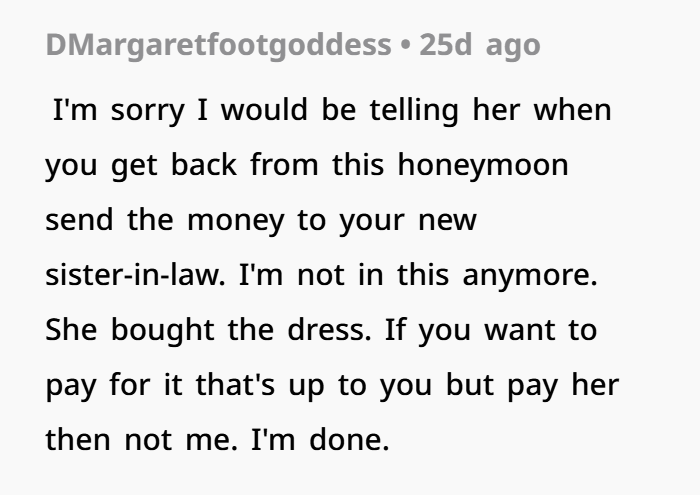
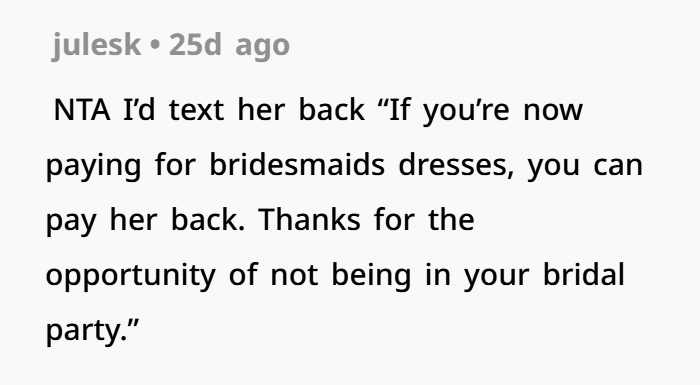
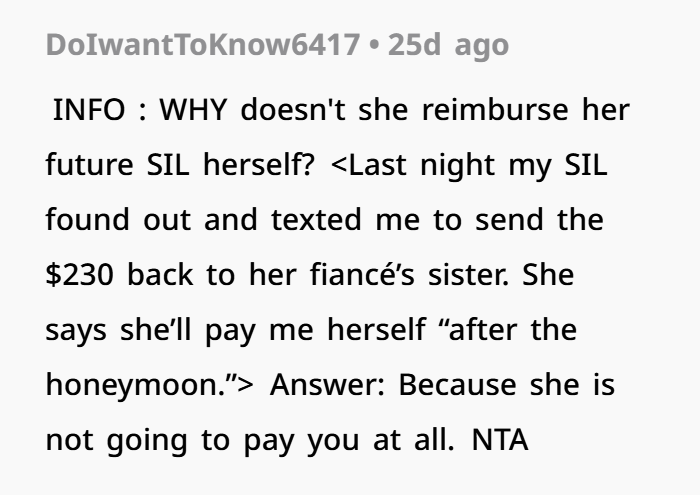
Unfortunately, the bride was not happy when she heard about the arrangement. She told the woman to send the $230 back to the replacement bridesmaid and said she would pay her after the honeymoon. The woman felt confused because the dress had already been sold and both sides were satisfied. She had spent her own money as part of the wedding budget and believed she had a right to recover the cost. Now she is questioning whether she should have waited for the bride to handle the payment or whether accepting money directly from the new bridesmaid was completely reasonable.

Bride Asks Former Bridesmaid to Return $230 After Selling Her Dress to Her Replacement
A woman spent $230 on a bridesmaid dress, only to find out weeks before the wedding that she was no longer part of the bridal party.
That was disappointing enough.
But then the bride asked her to give the dress to the woman replacing her.
The original bridesmaid didn’t want to lose the money she had spent, so she asked to be paid for the dress.
The bride offered just $100, saying the dress had already been used during fittings.
However, the replacement bridesmaid, who was the groom’s sister, saw things differently.
When she learned that the original bridesmaid had paid for the dress herself, she sent her the full $230.
The dress was handed over, and the problem seemed to be solved.
Then the bride made another request.
She wanted the original bridesmaid to return the money and wait until after the honeymoon to be paid by the bride instead.
The woman refused.
Now, the question is simple: Was she wrong for keeping the $230?
She Bought the Dress, So Why Should She Give It Away?
The biggest detail in this story is who paid for the dress.
The original bridesmaid bought it with her own money.
She spent $230 because she believed she would be standing beside the bride on her wedding day.
The bride may have chosen the color and style, but she didn’t pay for the dress.
That matters.
When you buy something, it normally belongs to you unless you have agreed to a different arrangement.
A bride choosing a dress for her wedding doesn’t automatically make her the owner.
And removing someone from the bridal party doesn’t mean that person’s belongings become available for someone else to use.
The original bridesmaid had every reason to keep the dress until someone paid for it.
She wasn’t asking for extra money.
She simply wanted to recover what she had spent.
The bride could change her wedding plans, but she couldn’t expect someone else to cover the cost for free.
Was the Dress Really Worth Only $100?
The bride’s first offer was $100.
That was $130 less than the original purchase price.
Her reason was that the bridesmaid had already worn the dress during fittings.
But trying on a dress is not the same as wearing it to a wedding.
Anyone who has bought formalwear knows that fittings are normal.
A dress might need to be shortened, adjusted at the waist, or checked to make sure it fits properly.
Sometimes that means trying it on more than once.
That doesn’t automatically make it a used dress.
Of course, the value of clothing can change depending on its condition.
A dress that has been damaged or heavily altered may sell for less than its original price.
But the Reddit story doesn’t mention any damage.
It also doesn’t say the dress had been worn to an event.
The bride needed this particular dress because there wasn’t enough time to get another matching one for the replacement bridesmaid.
So the dress was still very useful.
If anything, having the right dress ready at the right time made the situation easier for the bride.
That is why the $100 offer felt unfair.
Being a Bridesmaid Can Cost More Than People Expect
A bridesmaid dress is often only one part of the expense.
There may also be shoes, jewelry, hair appointments, makeup, travel, and hotel costs.
Some bridesmaids help pay for a bridal shower or bachelorette party too.
Before long, being part of a wedding can become a major expense.
This is why wedding budgeting and financial planning are worth discussing before anyone agrees to join a bridal party.
Couples should try to be clear about what their bridesmaids will need to pay for.
And bridesmaids should feel comfortable asking questions about costs.
In this story, the original bridesmaid had already spent $230.
Then the bride changed the wedding arrangements.
There isn’t one rule that says a bride must always refund every expense when someone leaves a wedding party.
It can depend on the situation, any agreements, and local laws.
But from a wedding etiquette point of view, it is considerate to think about the money someone has already spent.
The original bridesmaid wasn’t demanding that the bride pay her for being removed.
She only asked for payment when someone else wanted to take the dress.
That is a fair difference.
The Groom’s Sister Made Everything Easy
The replacement bridesmaid could have made this situation much more uncomfortable.
She was joining the bridal party at the last minute and needed a matching dress.
She could have asked the original bridesmaid to accept the bride’s $100 offer.
But she didn’t.
When the groom’s sister found out that the dress had cost $230, she paid the full amount.
No argument.
No pressure.
She simply paid for the item she wanted.
The original bridesmaid got her money back, and the groom’s sister got the dress she needed.
That sounds like a good outcome for both women.
The replacement bridesmaid also showed that she understood the original bridesmaid’s position.
She didn’t expect someone else to lose money because the wedding plans had changed.
A simple, fair payment solved a problem that could have become much bigger.
Unfortunately, the bride didn’t see it that way.
Why Did the Bride Want the Payment Returned?
After the groom’s sister bought the dress, the bride told the original bridesmaid to send the money back.
She said she would pay for the dress herself.
But she wouldn’t do it until after the honeymoon.
That left the original bridesmaid confused.
The dress had already been sold.
The replacement bridesmaid had paid the agreed amount.
And the dress had already been handed over.
Why should the original owner undo the payment?
The story doesn’t explain the bride’s reason.
Maybe she felt that the groom’s sister shouldn’t have to pay.
Maybe she wanted to take responsibility for the cost.
Those are possible explanations, but we don’t know for sure.
What we do know is that there was a much easier way to handle it.
If the bride wanted to pay for the dress, she could send $230 directly to the groom’s sister.
The original bridesmaid wouldn’t need to be involved at all.
Instead, the bride asked her to return money she had already received.
That created another disagreement when the first one had already been settled.
Why Waiting Until After the Honeymoon Wasn’t Fair
Imagine selling something for $230.
The buyer pays you.
You hand over the item.
Then someone else asks you to return the money and promises to pay you several weeks later.
Would you agree?
Probably not without a very good reason.
That was the position the original bridesmaid was in.
If she returned the payment, she would no longer have the dress or the money.
She would have to wait for the bride to pay her.
And remember, the bride had already argued that the dress was worth only $100.
It makes sense that the original bridesmaid didn’t want to take that risk.
This is an example of why personal budgeting and money management matter, even when friends and family are involved.
A promise to pay later is not the same as money already received.
The original bridesmaid wasn’t required to lend the bride $230 just because the bride wanted to change who covered the expense.
The bride could settle that issue directly with her future sister-in-law.
Was the Bridesmaid Being Petty?
Some people might say the original bridesmaid should have been more understanding.
Weddings can be stressful, and the bride was trying to make sure everything was ready.
But being understanding doesn’t mean you have to agree to every request.
The original bridesmaid had already been removed from the wedding party.
According to the story, she didn’t demand to be included again.
She didn’t try to stop the replacement from wearing the dress.
She simply wanted to be paid before giving away something she owned.
That is not unreasonable.
There is also a difference between being upset about a decision and trying to punish someone for it.
The woman wasn’t asking for more than she originally spent.
She accepted a straightforward