My FIL Offered $5,000 for Our Wedding Bar—Then Tried to Turn His Speech Into a Business Advertisement
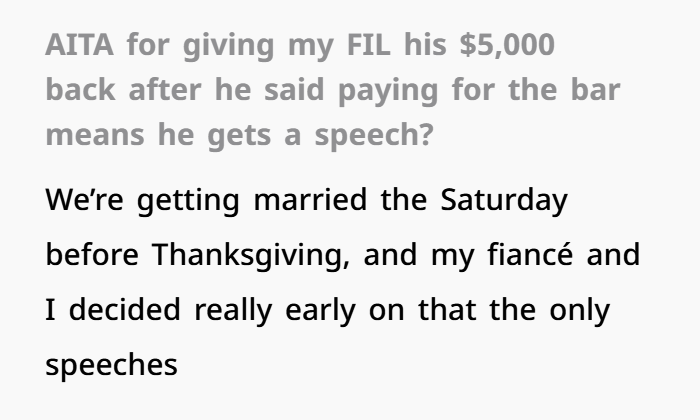
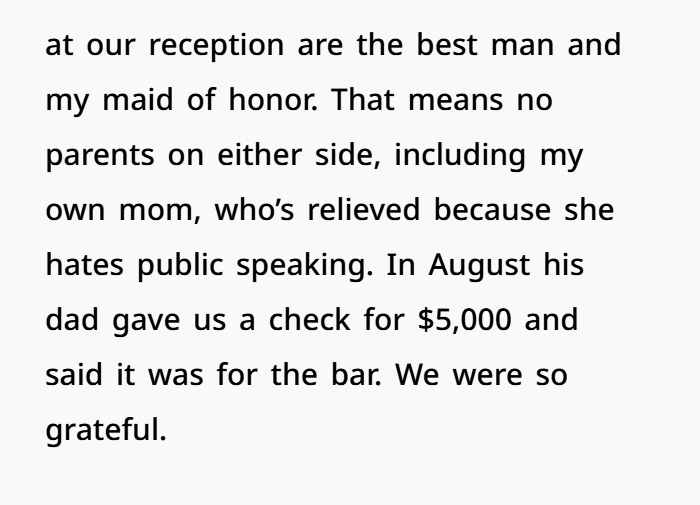
Wedding planning can be expensive, so one couple felt lucky when the groom’s father offered to help with their reception costs. Their wedding was planned for November, and he gave them a $5,000 check in August to pay for the bar. The couple was thankful because the money would make their wedding budget easier to manage. They had already decided that only the best man and maid of honor would make speeches. Parents from both families were not included in the speaking schedule. The couple put the check away safely and planned to use it when their final wedding venue bill arrived.
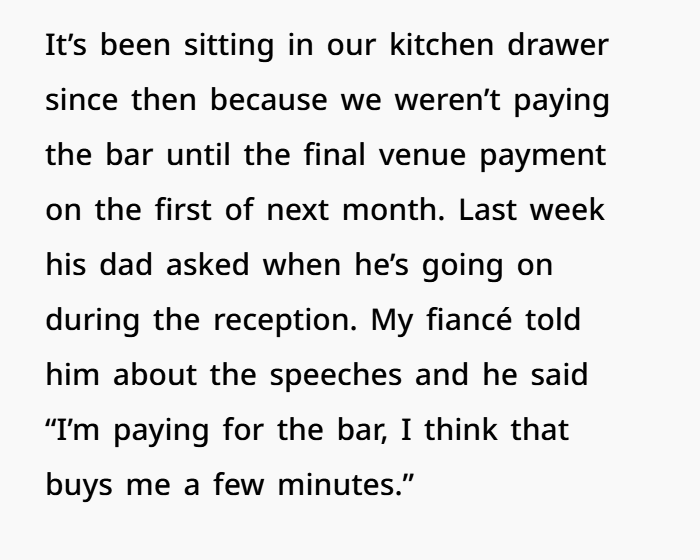
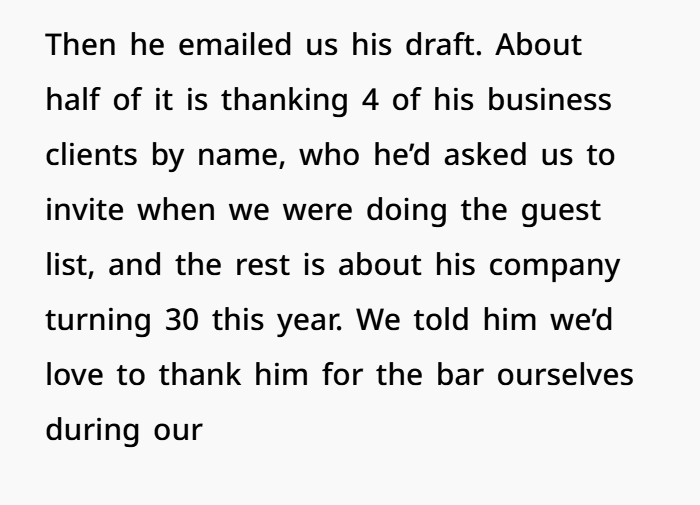
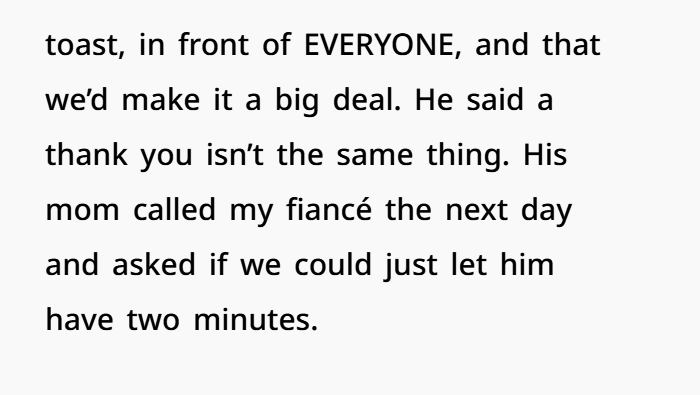
A problem started when the groom’s father asked what time he would be speaking at the reception. The couple explained their decision, but he did not agree with it. He felt that paying $5,000 toward the wedding should give him a chance to speak. He even emailed them the speech he wanted to deliver. Instead of sharing memories about the couple, he spent much of the speech thanking four business clients and talking about his company’s 30 years in business. The clients were also attending the wedding because he had asked the couple to invite them. This made the bride and groom uncomfortable because they wanted their wedding reception to focus on their marriage, not a business celebration.
The couple tried to find a fair solution. They offered to thank the groom’s father during their own toast and tell everyone about his generous financial contribution. They thought this would be a nice way to recognize his help without changing the event schedule. But he said that being thanked was not enough. He wanted to stand up and give his speech himself. Later, the groom’s mother called and asked them to give him two minutes with the microphone. The couple talked about their options and decided they would rather cover the extra wedding expenses than change a rule they had made for both families.
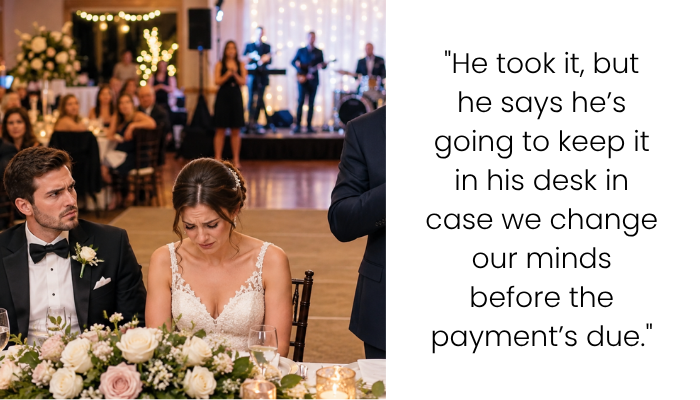
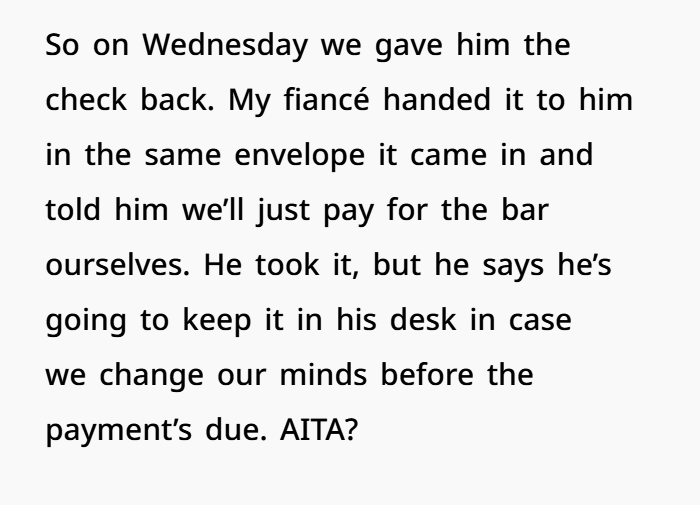
The groom returned the $5,000 check to his father on Wednesday, using the same envelope it came in. He explained that they would pay for the reception bar themselves. His father took the check but said he would keep it in his desk in case they needed the money before the final venue payment. The couple now feels unsure about what happened. They appreciate his willingness to help with their wedding costs, but they do not think financial support should decide who gets to speak. They are wondering whether returning the money was a fair way to keep control of their wedding plans.

Father-in-Law Gives Couple $5,000 for Their Wedding, Then Demands a Speech About His Business
A $5,000 wedding gift sounds like a wonderful surprise, especially when a couple is trying to manage expensive wedding plans.
But for one bride and groom, that generous offer quickly turned into a family disagreement.
The groom’s father had offered $5,000 to help pay for the wedding reception bar.
At first, there were no special conditions attached to the money.
But as the wedding got closer, he decided that his contribution should earn him a chance to speak during the reception.
The couple had already decided not to include speeches from parents.
Things became even more uncomfortable when they saw what he wanted to say.
Instead of focusing on the newlyweds, his speech was mostly about his business and its 30th anniversary.
The couple eventually returned his uncashed check.
Now the question is whether returning $5,000 was too much, or whether they were right to keep their original wedding plans.
The $5,000 Was Supposed to Help With Wedding Expenses
Weddings can be expensive, even when couples try to keep things simple.
There are venue rental costs, catering services, decorations, photography, and many other expenses.
The reception bar can also take up a large part of the wedding budget.
That’s why the groom’s father’s offer seemed so helpful.
In August, he gave the couple a $5,000 check to cover the bar.
The couple understood it as a gift.
They were grateful for the financial support and had no reason to think he expected something in return.
There was no agreement about giving him a speech.
There was no discussion about changing the wedding reception schedule.
But later, the father-in-law connected the money to a request the couple hadn’t approved.
That’s when the disagreement began.
He Believed Paying for the Bar Should Earn Him a Speech
As the wedding approached, the groom’s father asked to speak during the reception.
The couple said no.
They had already decided that neither set of parents would give speeches.
It was a general rule for the wedding, not something aimed at the father-in-law.
But he didn’t accept their answer.
He argued that paying $5,000 for the bar should give him a few minutes with the microphone.
That left the couple in an uncomfortable position.
They appreciated the money, but they didn’t want to change their plans.
They offered to thank him publicly for his generous contribution.
However, he still wanted to deliver his own speech.
The couple began to feel that the gift came with an expectation they had never agreed to.
His Planned Wedding Speech Was Mostly About His Business
Wanting to give a speech at your child’s wedding isn’t unusual.
Many parents enjoy sharing family memories and offering kind words to the newlyweds.
A short, heartfelt toast can be a lovely part of a wedding reception.
But the father-in-law’s speech was different.
According to the couple’s account, about half of it focused on thanking four business clients.
The rest discussed his company’s 30th anniversary.
Very little of the speech was about the bride and groom.
The four clients had already been invited to the wedding at his request.
Now he wanted to recognize them during the reception.
It’s possible he simply wanted to thank people who had supported his business over the years.
But the couple didn’t want their wedding celebration to become a business networking event.
They had planned the day to celebrate their marriage.
And they wanted the reception to stay focused on that.
Why the Speech Wasn’t Just a Small Request
Some family members might wonder why the couple couldn’t simply allow a short speech.
After all, the father-in-law had offered a large amount of money.
But the issue wasn’t only about giving someone two minutes.
The couple had already made a decision about their wedding schedule.
Neither the bride’s parents nor the groom’s parents had a speaking role.
Allowing one parent to give a speech could lead to questions from others.
It might also make the couple feel that their original plans could be changed whenever someone offered money.
And the speech itself didn’t match what they wanted for their reception.
A wedding toast about the couple might have been easier to discuss.
A speech focused on business clients and a company anniversary created a different concern.
Why Financial Gifts Can Create Family Expectations
Money can make family relationships complicated.
Parents often help their adult children with major expenses.
That might include wedding costs, a home down payment, or other important life events.
These gifts can be wonderful expressions of love.
But disagreements may happen when people have different ideas about what the money means.
Social psychologist Robert Cialdini has discussed a principle called reciprocity.
In simple terms, people often feel they should return a favor when someone does something generous for them.
For example, when parents help pay for a wedding, the couple may want to thank them in a special way.
That is normal.
But gratitude doesn’t mean the couple must agree to every request.
The bride and groom were willing to thank the father-in-law publicly.
They just didn’t want to give him control over part of the reception.
From their point of view, the gift was starting to feel more like a business arrangement.
Why Wedding Planning Can Create Family Tension
Weddings bring families together, but they can also create disagreements.
Parents may have their own ideas about how the celebration should look.
They might want certain guests invited, special traditions included, or particular people given speaking roles.
The couple may have different plans.
This can become especially difficult when parents are helping with wedding expenses.
A parent who pays for wedding catering may expect to help choose the menu.
Someone covering part of the venue rental may want more guests invited.
Another family member might want a say in the decorations or reception schedule.
These expectations can create stress when they aren’t discussed early.
The couple in this story believed they were free to plan their own reception.
The father-in-law seemed to believe his contribution gave him more influence.
Because they hadn’t discussed that difference, the situation became a family dispute.
Why the Couple Returned the $5,000 Check
Rather than continue arguing, the couple decided to return the check.
They had not cashed it.
That made the decision easier because the money hadn’t already been spent.
They also agreed to cover the reception bar themselves.
It was a costly choice.
An extra $5,000 could affect their wedding budget and other financial plans.
But the couple decided they would rather pay the expense themselves than accept money tied to a demand.
Returning the check removed the main reason the father-in-law was using to ask for a speech.
He could still attend the wedding and celebrate with the family.
But the couple would no longer be accepting his financial contribution.
For them, that seemed like the clearest way to settle the disagreement.
Was Returning the Money an Overreaction?
People may have different opinions about the couple’s decision.
Some might believe they should have accepted the money and allowed a short speech.
Others may feel that returning the check was the best way to protect their plans.
Both views are understandable.
The father-in-law may have felt that speaking at his son’s wedding was an important family tradition.
He may also have been disappointed that his offer was returned.
But the couple had their own reasons for saying no.
They had already decided against parental speeches.
They didn’t want a business-focused announcement during their reception.
And they didn’t want the financial gift to determine who could speak.
Returning the money meant accepting a real financial cost.
It wasn’t simply saying no and expecting someone else to pay.
They were willing to take responsibility for the bar expense themselves.
The Groom’s Mother Asked for Just Two Minutes
The groom’s mother tried to help settle the disagreement.
She asked the couple to let the father-in-law speak for only two minutes.
At first, that might sound like a reasonable compromise.
Two minutes isn’t a long time.
But the couple’s concern was bigger than the length of the speech.
They had already planned a reception without speeches from parents.
They also knew the father-in-law wanted to discuss his business.
Allowing him to speak could create pressure to make other exceptions.
The bride’s parents might wonder why they weren’t offered the same opportunity.
And the couple might feel they had changed their plans because of the money.
A compromise works best when both sides are comfortable with it.
In this case, the couple didn’t want to make that change.
Does a Wedding Gift Give Someone Decision-Making Power?
This situation raises an important question.
If parents help pay for a wedding, should they have more control over the celebration?
There isn’t one answer that works for every family.
Some couples are happy to let parents make certain decisions in exchange for financial help.
For example, parents might offer to pay for extra guests if the couple agrees to invite them.
Other couples prefer to make all the decisions themselves.
Both arrangements can work when everyone understands the expectations.
The problem comes when conditions are introduced after the money has already been offered.
In this story, the father-in-law originally said the $5,000 was for the reception bar.
He didn’t explain that the money came with a request for speaking time.
If he had made that condition clear from the beginning, the couple could have decided whether to accept it.
Instead, the expectation appeared later.
That left everyone frustrated.
What Is the Difference Between a Gift and an Agreement?
There can also be legal questions when someone gives money for a wedding.
Under general U.S. legal principles, a gift and a contract are different.
A gift is usually given without expecting a specific service in return.
A contract generally involves an agreement between the people involved.
If someone clearly offers money in exchange for a particular arrangement, the other person can choose whether to agree.
But adding a new condition later doesn’t automatically create a binding agreement.
The exact legal rules depend on the situation and local laws.
The fact that the couple never cashed the check may also matter.
In this case, returning the check helped avoid a bigger disagreement about what the money entitled the father-in-law to receive.
For complicated financial questions, a qualified attorney can explain the relevant laws.
How Couples Can Avoid Wedding Money Disagreements
Financial help from family can make wedding planning easier.
But it helps to have clear conversations before accepting large contributions.
Couples should understand what the money is intended to cover.
They should also ask whether the person giving it has any expectations.
For example, a parent might want to help pay for wedding catering but also hope to invite a few close friends.
Another relative might offer to cover the reception bar without wanting any involvement in planning.
Knowing these details early makes it easier to build a realistic wedding budget.
It can also prevent confusion after wedding deposits have been paid and vendor contracts have been signed.
Clear communication doesn’t have to make family gifts feel formal or uncomfortable.
It simply helps everyone understand what has been agreed upon.
Why Family Boundaries Matter After Marriage
Marriage often brings changes to family relationships.
The bride and groom begin making more decisions together as a couple.
Parents may still be involved and supportive, but they won’t always have the final say.
That adjustment can be difficult for some families.
Psychiatrist Murray Bowen studied how family relationships can affect people’s behavior during important life changes.
His work helps explain why major events, including weddings, can create tension.
Parents may feel emotionally connected to the celebration.
The couple may want more independence.
Both feelings can exist at the same time.
The important part is finding a way to respect each other’s roles.
In this situation, the couple wanted to make their own choices about the reception.
Returning the check was their way of keeping that decision in their hands.
Can the Family Move Past This Disagreement?
The father-in-law may still feel hurt about what happened.
He offered a large amount of money and may have expected a special role in the celebration.
The couple may also feel disappointed that the gift became a source of pressure.
But this disagreement doesn’t have to define their family relationship.
A calm conversation could help everyone understand what went wrong.
The father-in-law could explain why speaking at the wedding mattered to him.
The couple could explain why they wanted to keep their reception plans unchanged.
They don’t have to agree on every detail.
They simply need to respect the final decision.
The father-in-law can still celebrate his son’s marriage and enjoy the wedding.
And the couple can still appreciate his original offer, even though they chose not to keep the money.
Final Thoughts
This wedding disagreement began with a generous $5,000 contribution toward the reception bar.
But things became complicated when the father-in-law decided the money should give him a speaking role.
The situation grew more uncomfortable when his planned speech focused heavily on business clients and his company’s anniversary.
The couple had already decided not to include parental speeches.
Rather than change their plans, they returned the uncashed check and agreed to pay for the bar themselves.
It was an expensive decision, but it allowed them to keep the wedding reception they wanted.
A financial gift can be a wonderful way to support a couple, but it shouldn’t automatically give the giver control over their wedding plans.
Clear expectations and honest communication can prevent many family disagreements.
And sometimes, choosing to pay for something yourself is worth more than accepting financial help that comes with unexpected conditions.
Comments You Can’t Miss