
Am I Being Used? When Your Partner Stops Working, Asks for Security, and Pulls Away Intimately
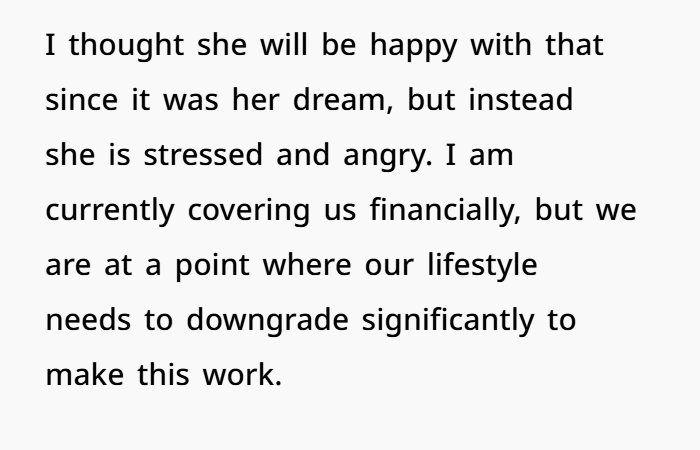
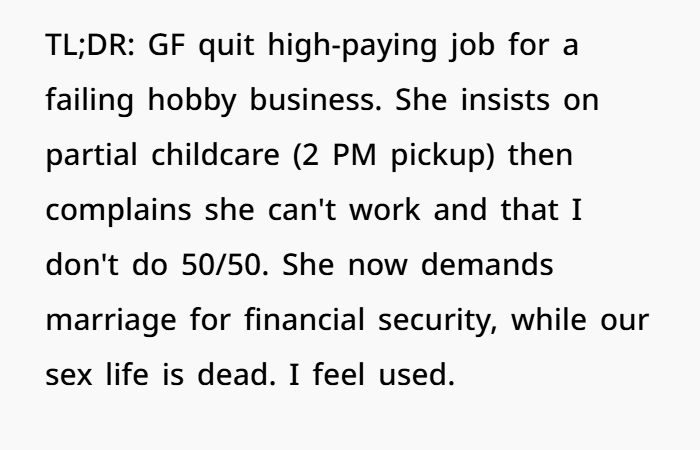
You’re in a long‑term relationship with your girlfriend of 6 years, raising two toddlers, living in Germany. She left a stable, well‑paying job to chase a passion project — a “hobby shop” and coaching business that isn’t thriving. You’re the sole financial provider now, and it’s dragging your lifestyle downward.
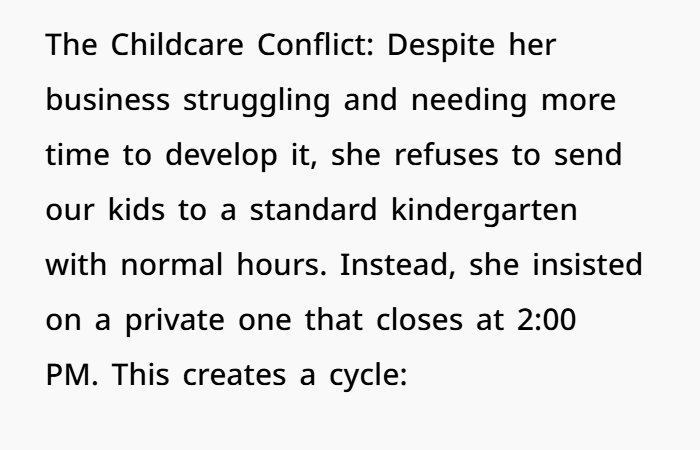
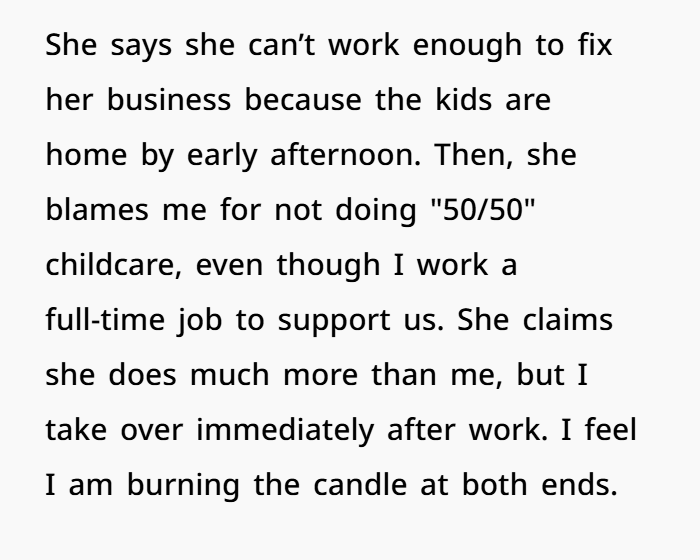
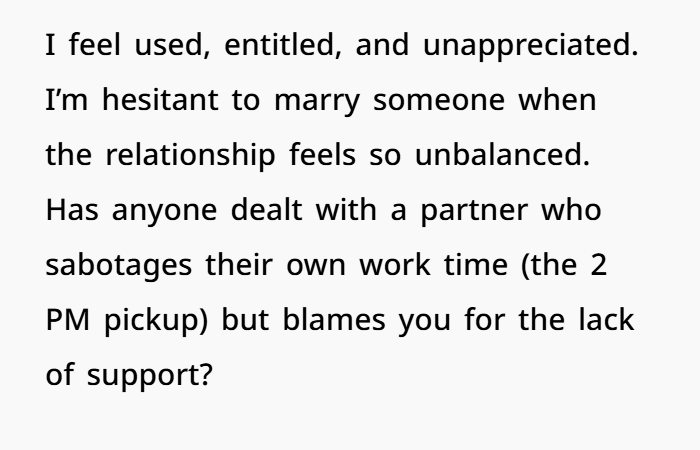
She refuses standard full‑day childcare, which would free up her time to actually work on her business. Instead, she insists on a private kindergarten that closes at 2 PM, making her available only part‑time. Then she blames you for not doing “50/50” childcare even though you’re working full time and doing a lot of house work.
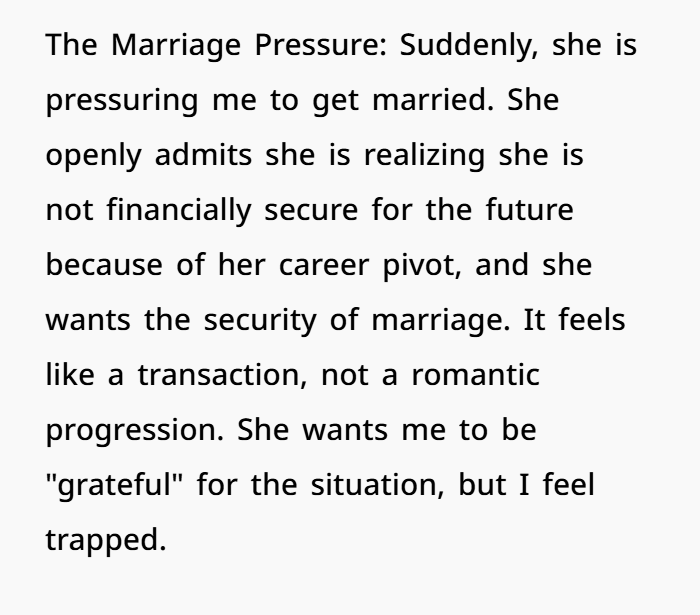
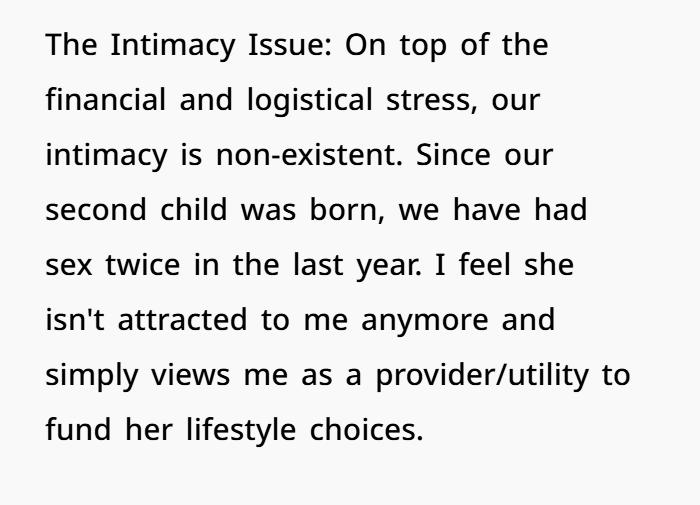
On top of this, she’s now pushing for marriage — but it feels like she’s after financial security rather than love. And your intimacy has evaporated, with you having sex only twice in the last year.
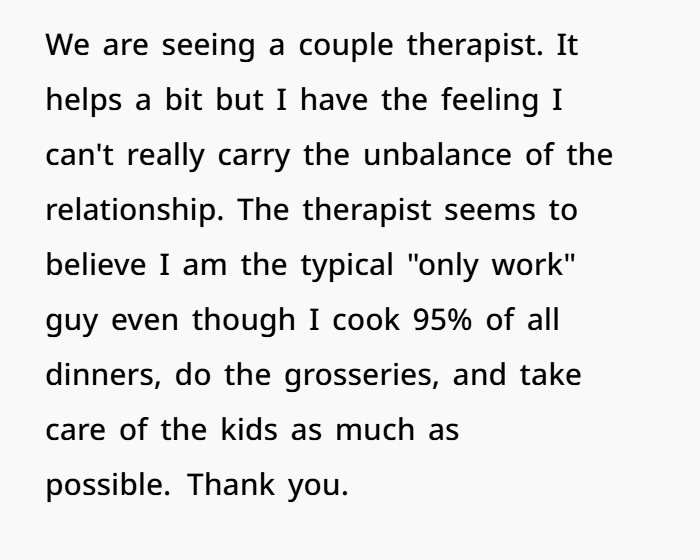
You’re resentful, burned out, and feel used. You’re in couple therapy, but it feels like the imbalance still weighs on you heavily.
Let’s unpack this with honest relationship advice, real communication strategies, and a calm exploration of your feelings so you can see your situation clearly and respond in a way that protects your well‑being and your children’s future.
A man felt he was in an unbalanced relationship, but his girlfriend kept asking for more

He was the one working full-time, taking care of the kids, getting no love in the bedroom, and being pressured to marry her
First off, thank you for sharing such a raw and honest situation. This is the kind of real life that doesn’t show up in movies — it’s messy, emotional, and deeply human. What you’re dealing with touches on big topics like relationship dynamics, emotional labor, financial responsibility, partnership expectations, intimacy & sex life, parenting balance, and even marriage as security vs. marriage as love.
Let’s break this down piece by piece in a way that feels conversational, grounded, and practical.
1. The Financial Reality: Not a Hobby, It’s a Responsibility

Your partner’s choice to leave a stable, state‑paid job to pursue a passion project is not inherently wrong. People change careers all the time. But what is unusual — and what creates real tension — is when the switch doesn’t work out, yet there’s no course correction.
You supported her financially and emotionally. That’s caring and generous. But a relationship is a partnership, not a safety net where one person carries 100% of the risk and burden.
This situation ties into financial stress in marriages, a huge factor in relationship satisfaction. When one partner feels like they’re carrying the weight and getting little in return — resentment grows. And from what you said, you’re already at that breaking point.
Her business isn’t making progress. And when the business isn’t working, someone needs to adjust. That might mean:
- reevaluating the business plan,
- finding part‑time paid work to support the household,
- adjusting childcare expectations, or
- rethinking the role each of you plays financially.
Right now, you’re the only one providing financially and emotionally holding things together.
That’s a recipe for burnout.
2. Childcare: A Block to Productivity or a Real Need?
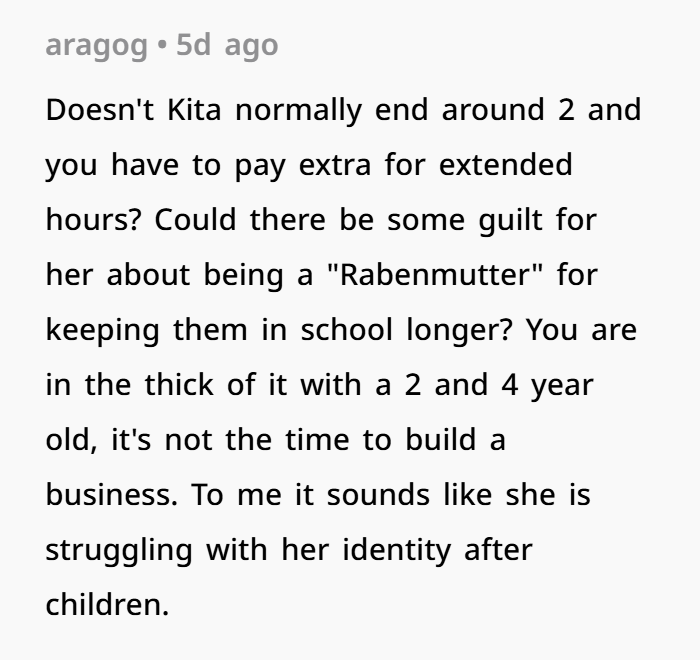
You pointed out something really important: her refusal to send the kids to a standard kindergarten with later hours. Instead, she insists on a private one that ends at 2 PM.
Let’s unpack that.
Raising toddlers is work. But so is trying to build a business. If she genuinely wants to expand her business, she needs uninterrupted time to do that — which is exactly what full‑day childcare gives.
Instead, she’s saying:
“I want more time with the kids”
but also
“I can’t work enough because the kids are with me.”
That’s a time conflict that can’t be solved by willpower alone — it needs real logistics and negotiation.

This situation is common in parenting disputes — one partner wants childcare that fits the business schedule, the other wants family time. The missing piece here is compromise and mutual respect for each other’s needs.
Right now, it feels like:
- You see childcare as a logistical solution to productivity.
- She sees childcare as emotional time with the kids.
- There is no medium ground.
Kids are important, and so is financial stability in a growing family. Both needs deserve respect — but you can’t have it all without compromise.
3. Marriage Pressure: Security or Transaction?
This part is huge. She’s now pushing for marriage, and you feel like it’s about security, not love.
This draws in something everyone struggles with at some point: emotional security vs financial stability.
Marriage can be practical — yes. Joint finances, legal protections, parental rights, stability for children. That matters. But when the reason for marriage feels like “I need a safety net,” it can make it feel transactional.
You said:
“It feels like she wants me for my income.”
When marriage is framed as a solution to insecurity, it stops feeling romantic and starts feeling like a contract.
That’s not how healthy long‑term partnerships are meant to feel. A partner should want you for who you are, not just what you provide.
And when someone explicitly says they want marriage for security while they are not contributing financially — that’s a red flag for many people.
Not because marriage can’t be practical — but because the motivation for it feels unbalanced.
4. Intimacy and Emotional Connection
Intimacy isn’t just physical sex — it’s a marker of emotional connection, desire, and partnership. When intimacy disappears, it often signals that one or both partners are emotionally checked out.
A stat often shared in relationship therapy is that after children are born, couples’ intimacy naturally dips — but consistent connection still needs effort on both sides.
Twice in a year is extremely low for most couples who feel intimate and connected.
You said:
“I feel she isn’t attracted to me anymore.”
That’s a painful place to be. When intimacy fades, partners can start to see each other as:
- roommate,
- parent,
- financier,
- caretaker,
rather than lover.
If her feelings shifted because of her own stress, anxiety, or disappointment about her career — that’s important to acknowledge. But it doesn’t excuse ignoring the emotional connection between you.
Intimacy needs reciprocity. It needs presence. It needs desire. If one partner feels used rather than loved, that kills intimacy faster than anything else.
5. You’re Carrying Too Much Emotional Labor
You said you cook 95% of dinners, do groceries, and handle as much childcare as you can after work.
That’s emotional and domestic labor — and it is work. One study shows that emotional labor can weigh just as heavily as paid work when it comes to burnout in relationships.
It sounds like you are giving both:
- Paid labor (your job)
- Unpaid labor (home, kids, chores)
while she does:
- half‑day childcare,
- hobby business work with minimal traction,
- pressure for marriage,
- little intimacy.
That imbalance creates resentment, and resentment doesn’t go away until the imbalance is corrected.
This is not about being ungrateful. It’s about fairness.
6. When You Set a Boundary and She Left
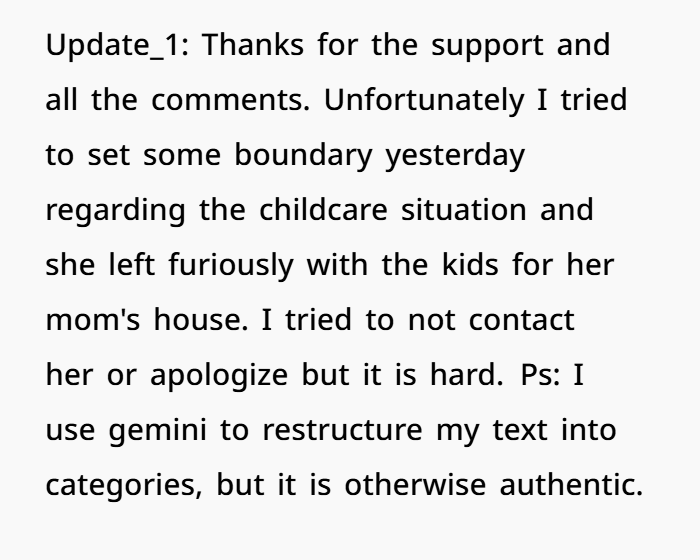
You wrote as an update that when you tried to set a boundary about childcare, she stormed off to her mom’s house with the kids.
That’s a red flag in itself — adults don’t handle conflict by removing the children and disappearing in anger. That’s not emotional regulation — that’s avoidance.
Healthy conflict — especially in a partnership with kids — means:
- talking through the issue,
- negotiating expectations,
- finding compromise,
- sometimes taking breaks from the conversation but returning to it.
Not disappearing with the kids in a fury.
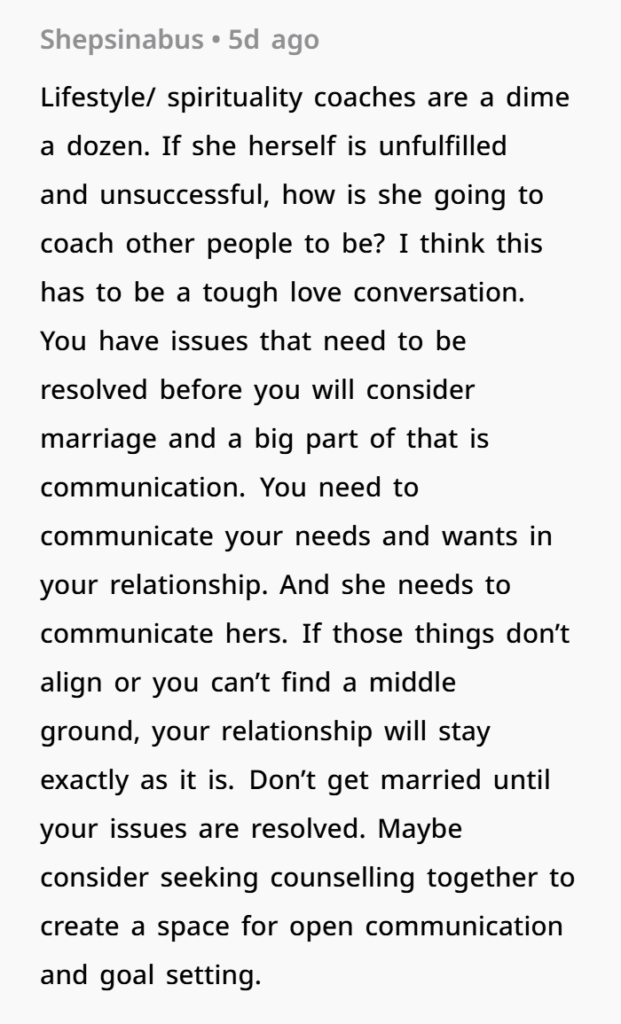
Your instinct to not chase or apologize immediately is understandable — because backing down every time creates a pattern where your boundaries don’t matter.
7. So What Should You Do?
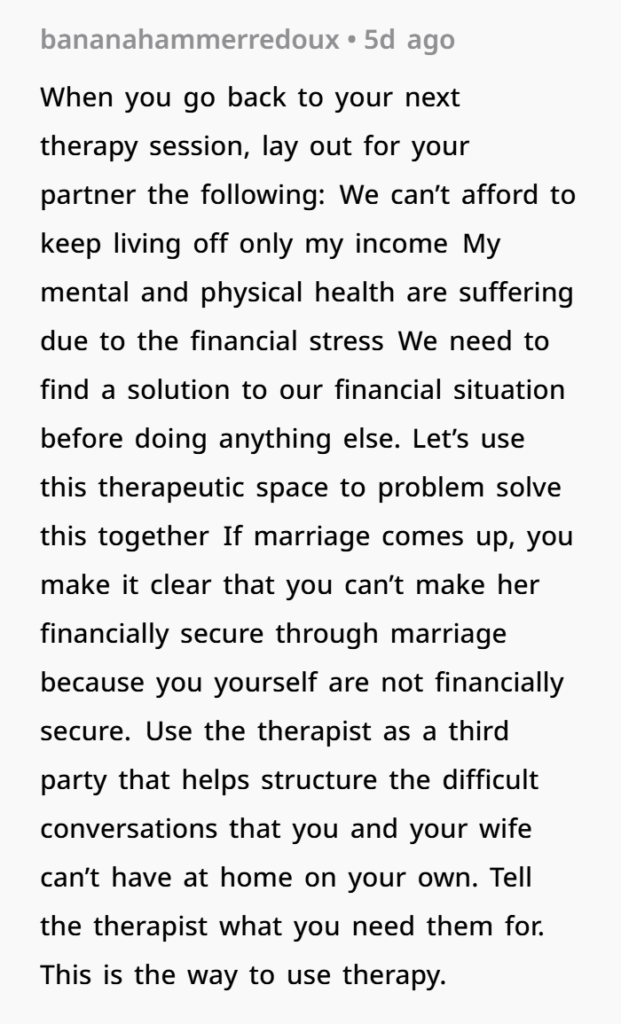
You’re already in therapy together — that’s a good start. Therapy helps when both partners are willing to do the work.
But here are some things to consider beyond that:
🌟 Reframe the Marriage Conversation
Ask her:
“What do you want from marriage — emotionally and financially?”
Not just “let’s get married for security.”
Real answers matter.
🌟 Reevaluate the Business Plan
If the hobby shop isn’t earning revenue, it may be time to pivot to something that brings in income — even part‑time employment. Not because she has to, but because support should be mutual.
🌟 Childcare Needs Should Be Practical
Full‑day kindergarten opens time for meaningful work. Partial daycare ends up confusing expectations. Work together on a solution that fits real schedules.
🌟 Talk Honestly About Intimacy
She needs to know how the lack of intimacy makes you feel and you need her honest feelings too. This is deeper than “we haven’t had sex.” It’s about connection.
🌟 Respect and Fairness Need to Be Rebalanced
Right now, it feels one‑sided. You may need to say:
“I love you, but I can’t carry everything alone. We need partnership.”
“Makes me wonder why I am still there,” he wrote in a reply to commenters

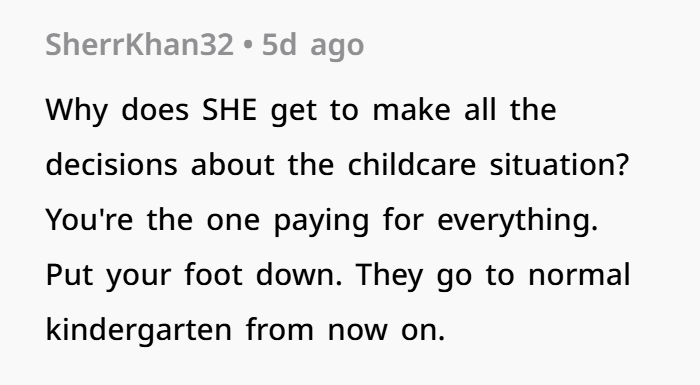
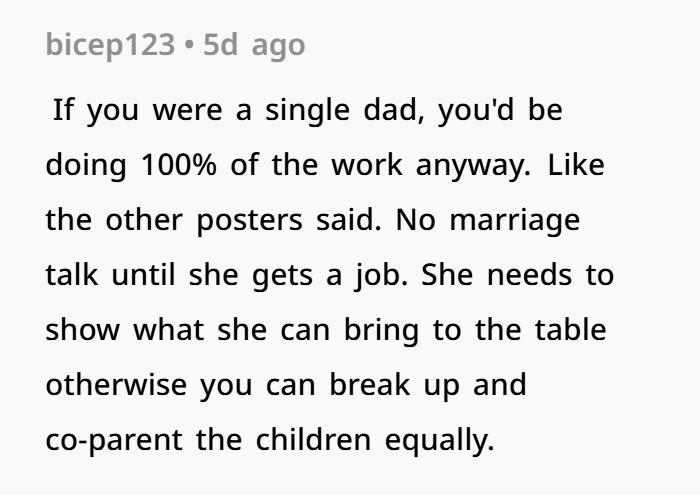

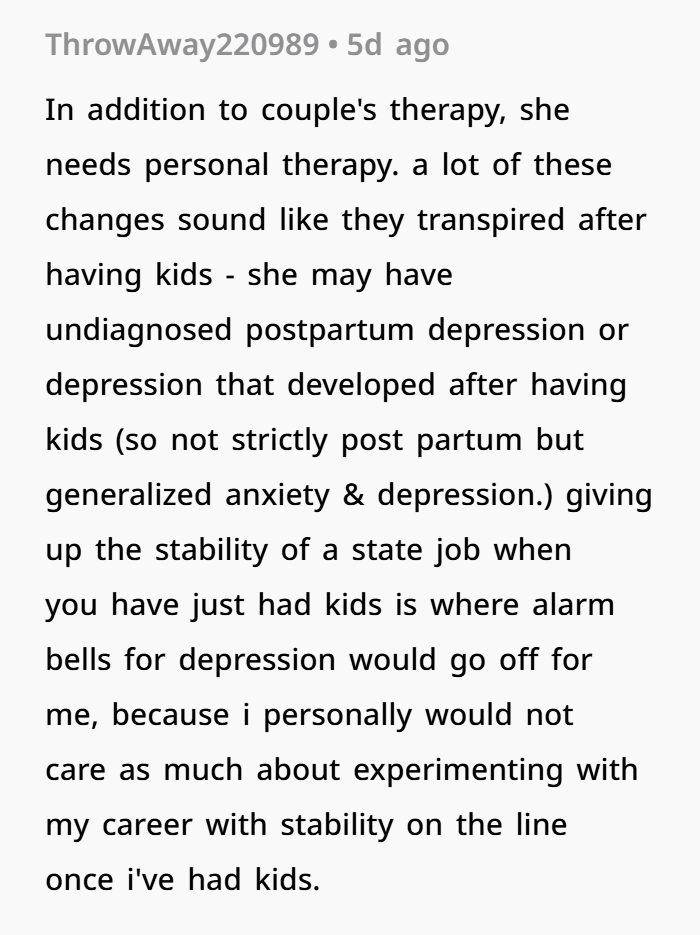

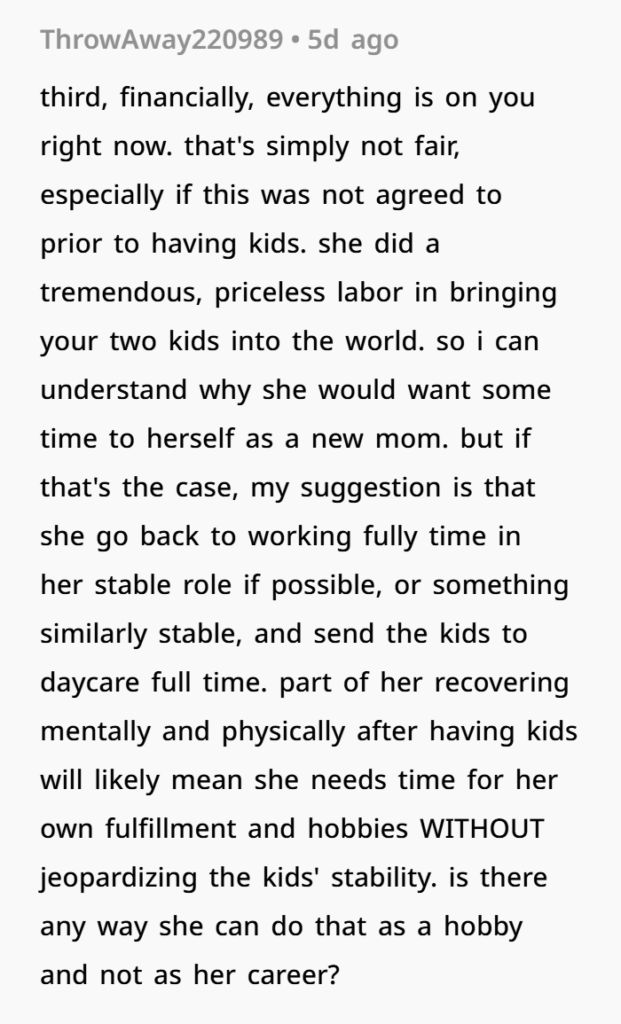
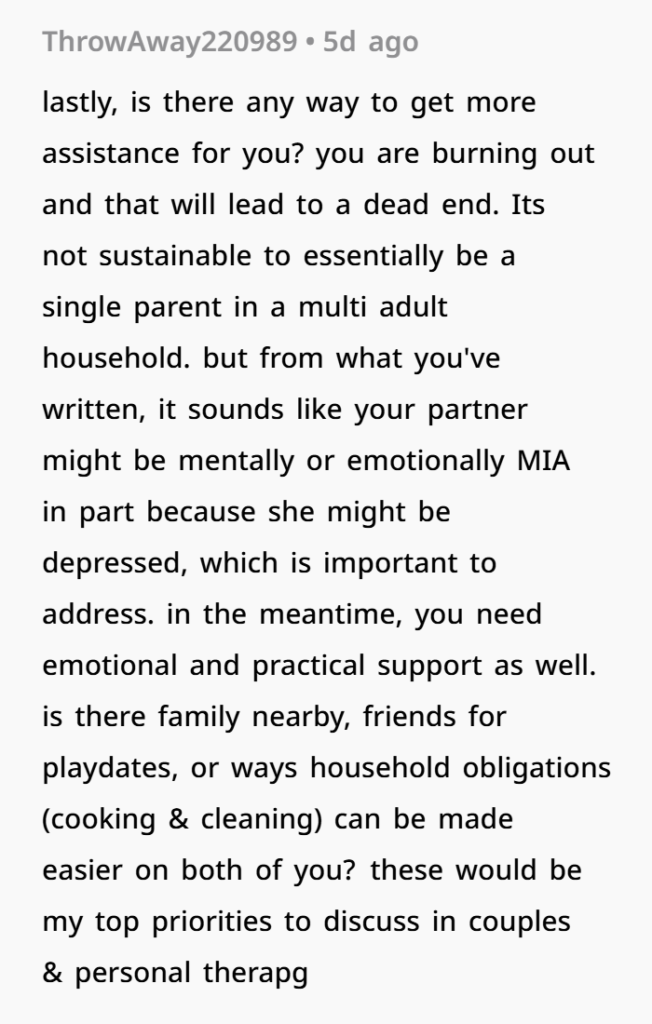
You are not a bad person for feeling overwhelmed, resentful, or used. You’re a human being trying to hold a family together while your emotional needs are being sidelined.
Your situation is complex — it involves relationship expectations, financial responsibility, parenting balance, intimacy issues, and emotional labor.
None of these are small. All deserve honest conversation and real adjustments.
Resentment doesn’t appear out of nowhere. It grows where needs are ignored.
You deserve:
- appreciation,
- partnership,
- mutual support,
- and yes — emotional and physical intimacy.
If that feels impossible right now, that’s not weakness — that’s clarity.
And clarity, even when painful, is the first step toward real change.