

Not Invited, But Expected to Pay? The Wedding Gift Drama That Split a Family
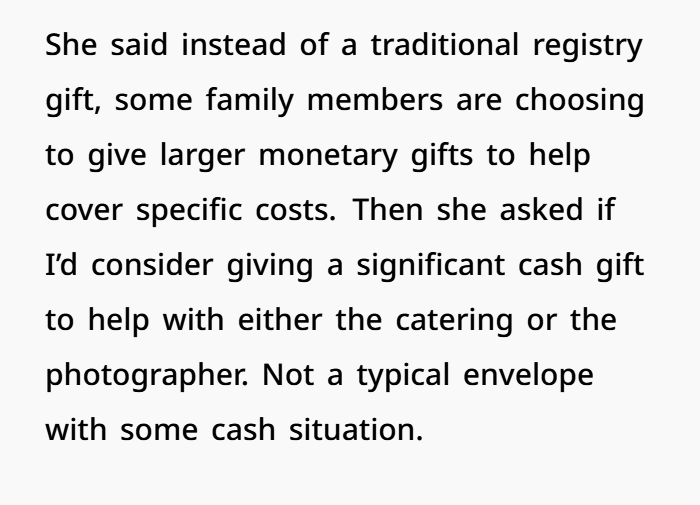
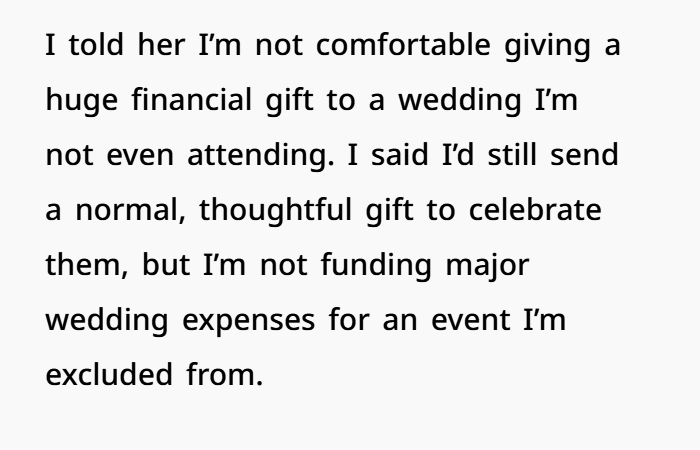
A 27-year-old woman was completely blindsided by family expectations when her aunt called to chat about her cousin’s high-budget upcoming wedding. It started like normal small talk. Then suddenly the topic shifted to money. Instead of a typical wedding registry gift, some relatives were apparently making large cash contributions to help cover major wedding expenses — catering costs, professional wedding photography, premium venue deposits. Not a couple hundred dollars in a congratulatory card. We’re talking thousands. Real wedding budget support. Her aunt framed it as generous, meaningful, a way to truly “support the couple.” She didn’t agree to anything. She just said she’d think about it.
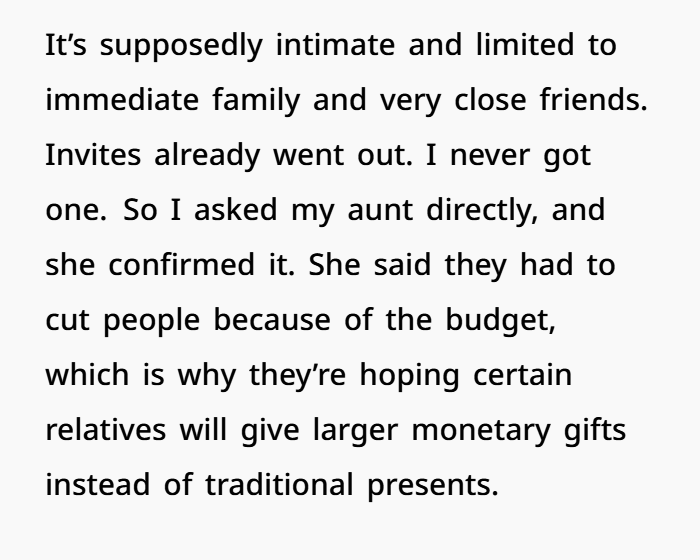
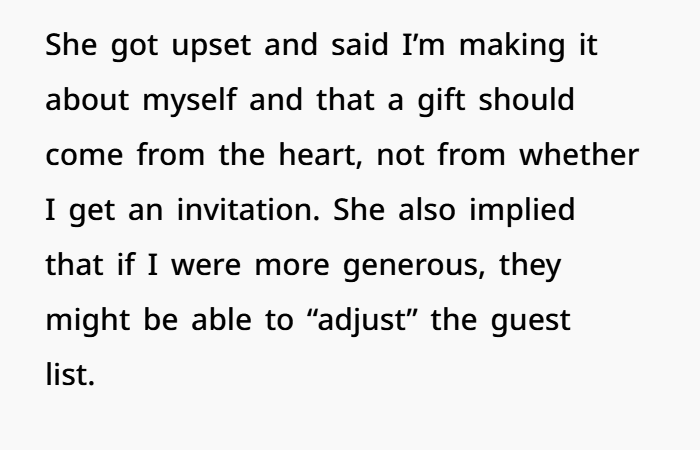
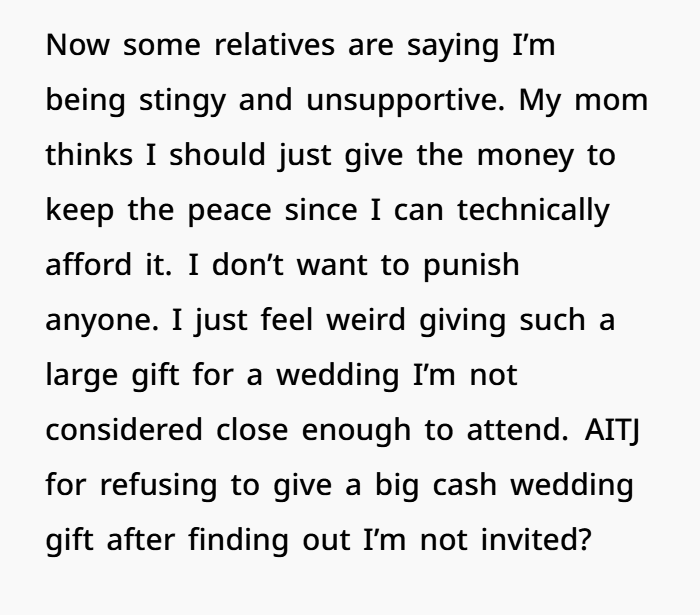
Then came the twist. She found out she wasn’t even invited. The wedding was described as intimate, limited to immediate family and very close friends. Invitations had already been sent. Hers never showed up. When she asked directly, her aunt confirmed she wasn’t on the guest list and blamed budget constraints — which is exactly why they were requesting larger monetary gifts from certain relatives. Basically, help finance the luxury wedding expenses, but don’t attend the event. When she declined to fund major costs for a wedding she won’t even see, she was labeled stingy and accused of making it about herself. Now she’s questioning whether setting a financial boundary makes her selfish — or if this is emotional manipulation dressed up as family support and wedding generosity.
Weddings are often billed as the happiest day of a couple’s life, but they can also be a surprisingly revealing look at human entitlement

The author was asked by her aunt to contribute thousands of dollars toward her cousin’s wedding expenses, instead of giving a traditional gift
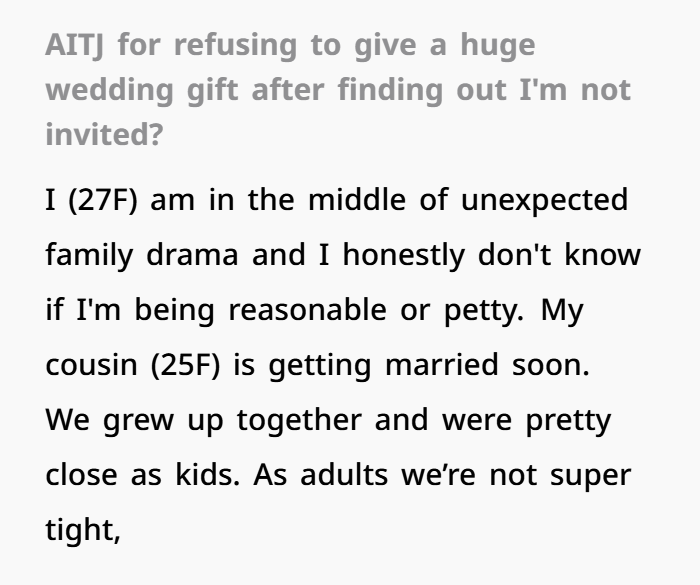
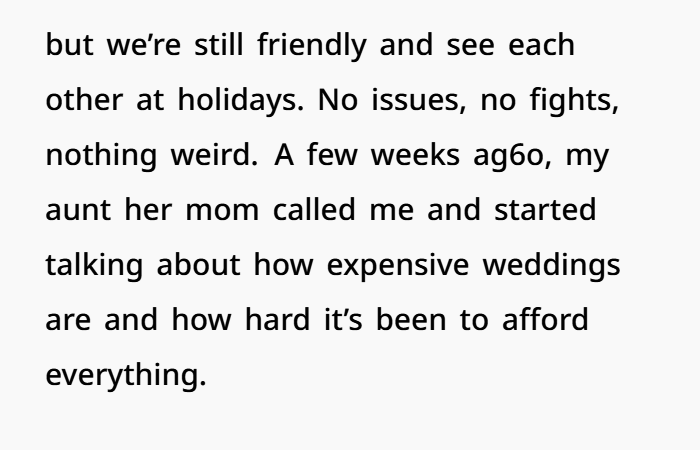


Let’s get something straight. Wedding culture has changed a lot over the years. The average U.S. wedding now costs serious money. Industry reports from companies like The Knot often show the average wedding cost going over $30,000 depending on the city, venue pricing, and vendor packages. That number shocks people, but it’s real. Catering services alone can run into the thousands. Professional wedding photography packages? Same story. Add in venue deposits, décor, and entertainment, and the total wedding budget climbs fast.
But here’s the thing. Expensive does not mean obligated.
There’s a big difference between a wedding gift and a financial contribution request. A wedding gift is traditionally voluntary. It’s meant to celebrate the couple and support their new life together. It’s not an entry fee. It’s not a sponsorship package. And it’s definitely not a condition for maybe being added to the guest list. Once money starts feeling required, it stops being a gift and starts feeling like a bill.
From an etiquette standpoint, long-standing norms — including guidance popularized by Emily Post — are pretty clear: you don’t solicit large gifts from people who aren’t invited to attend. Even sending wedding registry information to someone not on the guest list is often viewed as tacky. The traditional rule is simple. An invitation implies hospitality. You invite people because you genuinely want them there to celebrate. Gifts are secondary. Optional. A gesture, not an obligation.
Here, the order feels reversed.
The aunt framed the lack of invitation as a wedding budget issue. And that’s fine. Smaller, intimate weddings are common. Couples cut guest lists all the time to manage costs. No one is automatically entitled to attend someone else’s big day. But asking someone for thousands of dollars while excluding them shifts the tone completely. It stops feeling like celebration. It starts feeling transactional. More like financing an event than sharing in it.

And then came the subtle pressure tactic: “If you were more generous, we might adjust the guest list.”
That’s not etiquette. That’s leverage.
There’s a psychological concept called guilt-based compliance. You see it a lot in family systems and even in relationship counseling conversations. It’s when someone wraps a request in moral language so that saying no feels like you failed some character test. Notice the phrasing: “A gift should come from the heart.” Sounds innocent. But underneath, it implies that if you don’t give, your heart isn’t in the right place. That’s subtle emotional pressure. It reframes a totally reasonable financial boundary as selfishness.
But money is not morality.
Let’s talk financial boundaries for a minute. In personal finance — especially high-value areas like wealth management, estate planning, and long-term financial planning — advisors constantly warn people not to confuse liquidity with obligation. Just because you technically have the cash available doesn’t mean it aligns with your financial goals. Smart money management means prioritizing emergency funds, retirement contributions, investment growth, debt reduction, and future asset protection. A surprise multi-thousand-dollar “gift” can absolutely derail a carefully built financial strategy.
And here’s the key point — weddings are discretionary expenses. They are not medical emergencies. Not housing crises. Not unexpected legal bills. They’re celebrations planned within whatever wedding budget the couple chooses.
If a couple can’t afford their dream catering company or luxury wedding photographer, the usual solution is scaling down. Fewer floral arrangements. Smaller guest list. Simpler menu. Different venue. What’s not standard financial planning? Outsourcing the cost to cousins who aren’t even invited.
There’s also a clear power dynamic happening. Family hierarchies create pressure. Younger relatives often feel obligated to comply with older family members to avoid conflict. When a parent says, “Just give the money to keep the peace,” what they’re really saying is that surface harmony matters more than fairness. That’s common in conflict-avoidant families where short-term comfort overrides healthy boundaries.
But peace bought with resentment isn’t real peace. It’s delayed conflict — with emotional interest added later.
Another important layer is social reciprocity. Gift-giving is built on mutual exchange. Not equal exchange, but relational exchange. When you attend a wedding, you give a gift partly because you were hosted. You shared the meal. You celebrated the couple. You were included. Even modern etiquette conversations in publications like Vogue and Brides point out that while gifts aren’t payment for attendance, there’s still a social rhythm involved. Inclusion naturally increases generosity. Exclusion tends to do the opposite.
Being excluded while asked to fund it disrupts that rhythm.

Now, is she required to give nothing? No. She already offered a thoughtful, normal gift. That’s actually generous considering she isn’t attending. Many etiquette experts would say a small congratulatory gift is optional but kind in this scenario.
But thousands? That shifts into sponsorship territory.
There’s also something subtle but important about how the aunt framed the cost cutting. She said they had to trim the guest list due to budget. If budget is tight, then requesting large financial contributions should reduce that pressure — meaning fewer guests should need to be cut, not more. The logic doesn’t fully add up.
And let’s examine the emotional undertone. The cousin didn’t call herself. The aunt did. That suggests this may not even be coming directly from the bride, but from parental stress. Weddings often activate parental pride and image concerns. Sometimes families overspend to maintain appearances. When costs spiral, they look for relief. But it’s not the extended family’s responsibility to stabilize that.
Another factor is fairness. If certain relatives are being privately approached for large sums, it creates invisible tiers of expectation. Who decides which cousin gets the “premium contribution” request? Why her? Because she can afford it? That introduces another uncomfortable layer — perceived financial access.
In personal finance law and estate planning circles, there’s frequent discussion around financial boundaries within families. Once someone becomes the “financially capable” relative, requests can multiply. Today it’s catering. Tomorrow it’s a down payment. Then it’s a business loan. Without clear limits, expectations expand.
Setting a boundary early prevents long-term resentment.
Her refusal was calm. She didn’t shame them. She didn’t blast them publicly. She simply said she’s not comfortable funding major expenses for a wedding she’s not attending. That’s measured. That’s adult.
The aunt’s reaction — labeling her as stingy — is emotional escalation. Not a sign she was wrong. Often when someone sets a new boundary in a family that isn’t used to hearing no, there’s backlash. Not because the boundary is unfair. But because it disrupts established patterns.
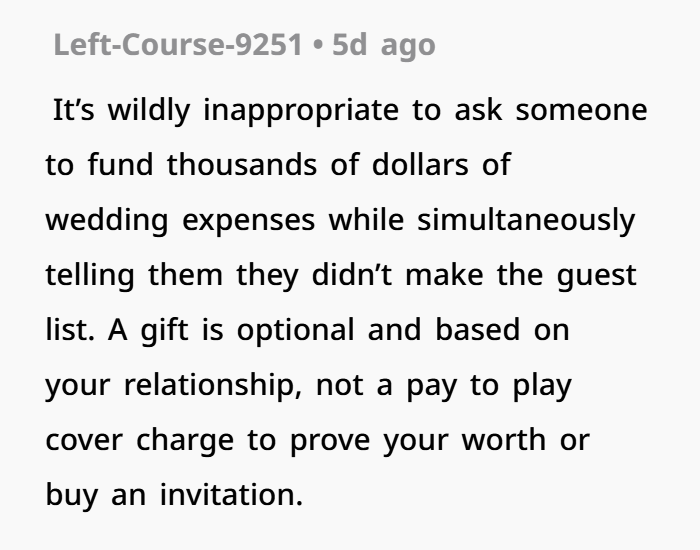
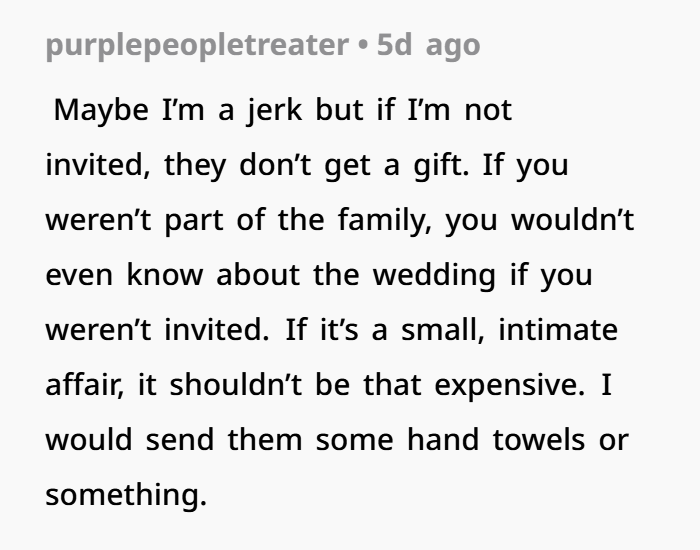
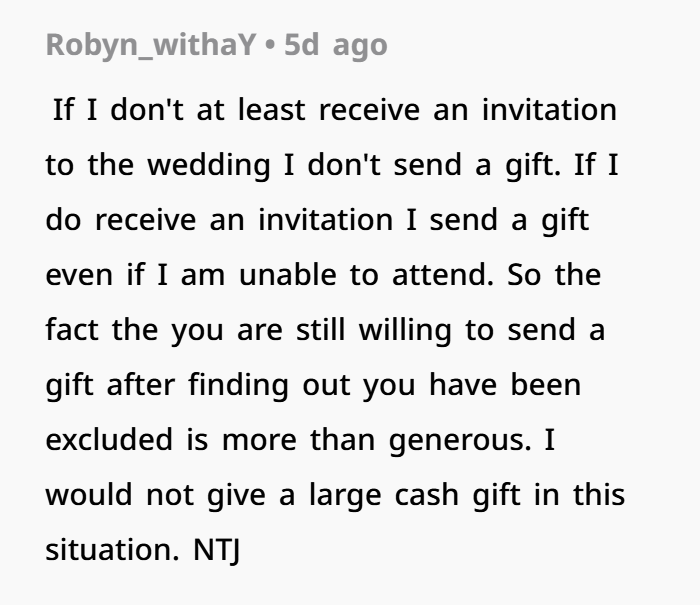
Netizens called the request “wildly inappropriate”, stressing that a wedding gift is optional and rooted in genuine connection





Let’s simplify it.
A wedding invitation is not a bill.
A gift is not a ticket price.
And generosity cannot be negotiated under pressure.
She isn’t punishing them. She’s declining to finance an event she’s excluded from. That’s not petty. That’s proportionate.
If they truly value her presence, they would invite her with zero financial conditions attached. No quiet expectations. No “we’d love your support” coded language. An invitation should mean we want you there, not we want your contribution. Real inclusion doesn’t come with a price tag or a wire transfer request.
If they genuinely value her support, they would appreciate whatever thoughtful wedding gift she chooses to give. Big or small. Cash, registry item, or even just a heartfelt note. A gift is voluntary. It’s not a mandatory wedding contribution or some kind of informal sponsorship deal. The second generosity gets measured by dollar amount, it stops being about love and starts feeling transactional.
And if they honestly can’t afford the luxury wedding they’re planning — the high-end venue, premium catering package, professional photography team — the answer isn’t family fundraising disguised as sentiment. The responsible move is adjusting the wedding budget, scaling the event to match their financial reality, and making decisions that align with smart money management. That’s how healthy financial planning works. Not by pressuring relatives to finance a celebration they’re not even invited to attend.
It’s resizing the wedding.
So is she the jerk?
No.
She’s just the only one in the conversation separating love from leverage.