
Co-Worker Framed Me for a $5,000 Theft, But Years Later Her Own Mistake Led to Justice

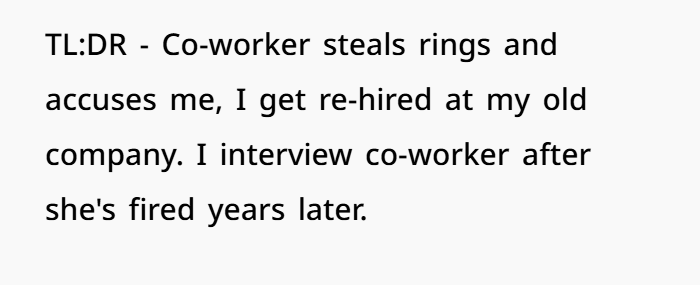
A workplace betrayal can change someone’s life in a matter of days. This story is about an employee who lost his job after a co-worker accused him of taking a $5,000 jewelry set.
There were no security camera records to prove what happened, and both sides had different stories. Because of that, he became the main person people suspected.
Years later, the truth finally came out. The same co-worker admitted what she had done, which led to criminal charges and a court case.
The situation ended with a surprising final meeting that gave him the closure he had been waiting for.
This workplace story shows how false accusations, employee misconduct, and office conflicts can create serious problems. It also shows why trust, fair workplace rules, and proper investigations are important for protecting employees from unfair treatment.




Sometimes revenge does not happen quickly. Sometimes it takes years before the truth finally catches up with someone.
For one former employee, the wait was almost a decade. After being blamed for a missing jewelry set at work and losing his job, he never forgot what happened. He moved forward with his life, built his career again, and eventually got the chance to face the person who had caused so much damage.
But the story started long before that final moment.
A Supportive Workplace and a Big Career Decision
For nearly ten years, the employee worked at Company A, a small business with only about ten workers.
The owner treated his staff like family. Everyone worked hard, sometimes putting in 60-hour weeks, but they were rewarded with good pay, bonuses, and special benefits.
When the owner’s son got married, he even gave the entire team a paid week off so they could attend the celebration.
Like any workplace, there were disagreements, but the employees knew they were valued.
After years of experience, the employee believed he was ready for a management role. When the manager position became available, he applied.
Unfortunately, he did not get the job.
The reason was simple: another candidate had a Business Administration degree, while he did not.
Instead of giving up, he made a difficult choice. He decided to leave the company and attend university to improve his career opportunities.
The owner understood his decision and supported him.
That choice would later change everything.
Starting Over at a New Company
While studying at university, he needed money for rent, food, and daily expenses.
His tuition was covered through government grants, but living costs were still a challenge.
He eventually found a part-time job at Company B, a retail business with around 50 employees.
The company sold many different products, from everyday items to expensive goods. It also had a reputation for high employee turnover.
He started working in the warehouse and reported to the Warehouse Supervisor.
Over the next seven years, he completed his degree and slowly moved up in the company.
He went from part-time worker to full-time employee and eventually became the Warehouse Supervisor.
That was when he hired a warehouse clerk named K.
K would later become one of the most important people in the entire story.
The Co-Worker Conflict Begins
Around the same time, another employee joined the company.
She started as a cashier but quickly moved into higher positions.
According to the employee, she was very skilled at making herself look good in front of management.
Eventually, she became the Sales Supervisor.
The two supervisors did not get along.
Their personalities clashed constantly.
She reported his mistakes to management but accused him of being a “snitch” whenever he raised concerns about her behavior.
She criticized him and his warehouse team, interrupted him during meetings, and often took credit for his ideas.
She also blamed others whenever something went wrong.
Customers were blamed. Delivery drivers were blamed. Other employees were blamed.
She was rarely willing to accept responsibility.
The Missing $5,000 Jewelry Set
The situation reached a breaking point when a customer’s expensive jewelry order arrived at the store.
The jewelry set was worth more than $5,000.
Because valuable items could easily be lost or stolen, the warehouse had a strict safety procedure.
After receiving expensive items, employees checked everything carefully before placing the products into the office safe.
The employee followed the exact process.
He received the jewelry, checked it, and then told K he was taking it to the office.
The only person available with access to the safe was the Sales Supervisor.
He asked her to open the safe.
Instead, she told him to leave the jewelry box on her desk because she was finishing an email and would put it away afterward.
He left.
The problem was that he never actually saw her place the jewelry into the safe.
The next day, management called him into the office.
The jewelry was missing.
The manager, the Sales Supervisor, and an HR representative were there.
The employee explained the steps he followed and said the last person who had the jewelry was the Sales Supervisor.
But she claimed the box was already empty when she checked it.
There was no camera footage because the store’s security system had stopped working days earlier.
With no proof, it became one person’s word against another.
Then the Sales Supervisor pointed the blame at him.
She argued that he was responsible because he was the last person seen with the jewelry.
The company decided to fire him.
They said they could not prove he stole anything, so they would not press criminal charges, but they still held him responsible for the missing items.
After years of hard work, his job ended in one day.
A Second Chance Appears
After losing his job, he worried about finding new employment.
He contacted the owner of Company A for a reference.
During that conversation, he received unexpected news.
The old manager position was becoming available.
The employee who had originally received the job was retiring because of health issues.
The owner had followed his progress during university and wanted him back.
This time, he accepted.
He returned to the company where he had started and finally got the leadership role he wanted years earlier.
Things seemed like they were finally moving forward.
But the past was not finished.
The Hidden Truth Comes Out
After his firing, K knew something was wrong.
She believed he would never steal the jewelry.
But she also knew that without proof, the Sales Supervisor would simply deny everything.
So K and her husband created a plan.
They became friendly with the Sales Supervisor.
They spent time together, attended social events, and built trust.
During conversations, K pretended to agree with the Sales Supervisor’s negative opinions about the former employee.
The Sales Supervisor believed she had found someone who supported her.
Months passed.
Then, during one gathering, K casually mentioned the missing jewelry.
That was when the Sales Supervisor made a shocking confession.
She admitted she wanted the jewelry and had stolen it.
She explained that she saw an opportunity because the cameras were broken.
She planned to take the jewelry, report it missing, and make him look responsible.
But she did not realize one important detail.
K’s husband had recorded the conversation.
The recording became the evidence everyone needed.
K gave the recording to management.
The police were contacted.
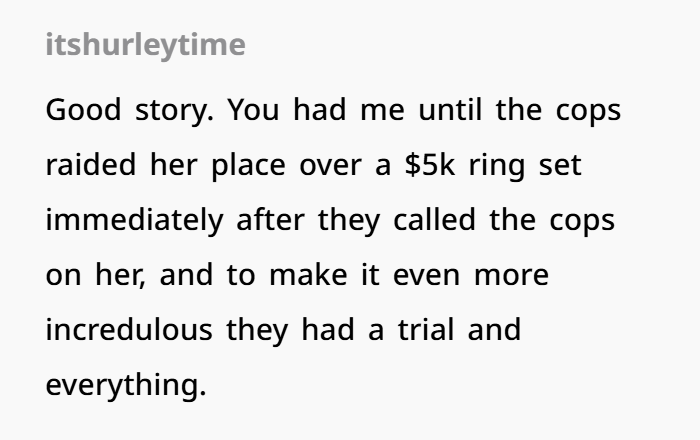
The jewelry was found at the Sales Supervisor’s home.
She was arrested and charged with theft over $5,000.
Court Case and Legal Consequences
The former employee was contacted by the prosecutor and asked to testify.
He agreed.
During the trial, he, K, and K’s husband explained what happened.
The recording of the confession was also presented.
The defense argued that K had intentionally encouraged the confession, but the judge rejected that argument.
The Sales Supervisor was sentenced to five years in prison.
She was unhappy with the decision, but the former employee felt justice had finally arrived.
He also took legal action.
He worked with a lawyer to file claims related to the damage caused by the false accusation and wrongful termination.
Company B settled after receiving notice of the lawsuit.
The former employee also pursued compensation from the person who framed him, including lost wages, emotional distress, and legal costs.
The Final Meeting Years Later
The final chapter happened when Company A needed to hire a new employee.
The owner reviewed applications and scheduled interviews.
One resume stood out.
It belonged to the same former co-worker.
She had applied without knowing who worked at the company.
The former employee recognized her name immediately.
Instead of throwing away the application, he decided to let the interview happen.
When she arrived, she walked in confidently.
Then she saw him.
Her expression changed instantly.
The person she had blamed years earlier was now the person sitting across from her.
He simply looked at her and said:
“Ah, Bitch, how are you? Remember me?”
She froze.
After looking over her resume, he politely ended the interview.
He told her she was not the right fit for the company.
She left without saying a word.
After almost six years away from her previous job, the person who once destroyed his career was now facing rejection from the very place where he had rebuilt his life.
See the comments to know what people said






This story is a reminder that the truth can take time, but it does not stay hidden forever.
A single false accusation changed a person’s career and caused years of stress, but he refused to let that moment define his future. Instead, he focused on rebuilding his life, returned to a company where he was respected, and finally got the justice he deserved.
The co-worker believed she had successfully escaped the consequences of her actions. But her own choices eventually exposed the truth.
Workplace trust is valuable, and when someone breaks that trust, the damage can affect many people. In the end, honesty, patience, and doing the right thing proved stronger than deception. The final interview was not just about revenge — it was a reminder that actions always have consequences.